2025
March 2025
We welcomed, again, the return of John Blakeley for Part 3 of his fascinating talk on military bases in the Arctic. As a quick recap Part One consisted of how the Arctic bases originated which was basically during World War 2(WW2). Part 2 followed the Cold War and brought the story up to date. Part 3 were a couple of modern films about what is happening now.
The first, made in France, followed a floating Nuclear Power Plant and its positioning in a remote part of the Arctic where a specially selected family were ‘allowed’ to give their impressions of the blessings of the power plant; in short an abundance of clean energy on their doorstep compared to a limited and old coal fired power station which preceded the Floating Power Plant. This allowed the family to have unlimited electricity. Working and living conditions are so extreme that there are numerous incentives to qualified personnel, including cheap housing and electricity. However even this family were a little concerned with having a nuclear power plant, which was deemed by the politicos as ‘unsinkable’ on their doorstep, or more accurately in their harbour. Anyone remember how it ended the last time ‘unsinkable’ was a proud boast and of course Russia doesn’t exactly have an unblemished history regarding nuclear accidents. Interesting though, and to be fair, the French journo’s were given good, although heavily, chaperoned access.
The second film followed a NATO combined operations force making a foray into the Arctic wilderness for troop training against some home grown Norwegian Troops pretending to be Russian aggressors. The object was to prove the viability of a Quick Reaction force including French ( Non NATO) troops and to prove and improve operations in deeply inhospitable terrain and climatic conditions. Overall it was an impressive demonstration of ability but of course those troops who grew up and trained full time had a big advantage. It certainly demonstrated what needed to be done to operate successfully; a very interesting film.
Mark Burch
Stand In Scribe
February 2025
Our own member David Allen was the speaker this month with a catchily entitled talk, consisting of his reminiscences of the purest form of flying: gliding.
David was born into an aviation family and spent much of his youth involved with, and later working on, aircraft and airlines way back when Pontius was a Pilate and not a pilot. Nonetheless, after he had settled into something more respectable he still had that urge to fly. His first move was the micro light; a
very small two-seater with an engine. Eventually, after going solo he realised that the only way to continue, without licensing restrictions, was instead, to join a shared ownership group involving considerably lower costs. Then, after another change of heart, he changed direction again and joined the Fenland Gliding Club at RAF Marham.
There are generally 2 ways of launching a glider from a standard flat aerodrome. The first and most common is by winch. This is connected by a very long wire to the glider. At the launch end the winch driver accelerates the glider to around 1200 ft. in a very short time. This is high enough to provide 5-7 minutes of flight training or, if you’re lucky and find a thermal, the sky is the limit.
The second method is by aero-tow: the glider is towed behind a light aircraft. This is more expensive but you can reach around 3000ft.This gives a much longer flight and a better chance of finding a thermal.
There were a few mishaps. On one occasion he breached security by dismantling a boundary fence which had to be rebuilt after retrieving the glider. The instructor admitted liability. This brought down the wrath of the Station Commander and lead to a full security briefing for all personnel.
David also had a gliding detachment to Sutton Bank near Thirsk in Yorkshire where the airfield is on a plateau about 1000 ft above the surrounding countryside. This provides very nicely for scenic flying and, hill soaring a distinct possibility. He was most impressed at the slick operation at Sutton Bank and also, that the club house has a panoramic view of the whole airfield.
Unfortunately Fenland Gliding Club came to an end when RAF Marham began to modernise in anticipation of the arrival of the F35 Lightning 2.
Mark Burch, Stand
January 2025
Arctic Military Bases Part II - John Blakeley
No report issued. John gave an interesting talk on the bases within the Arctic Circle, often the forgotten yet vital to all participants in the Cold War
May 2025
"V for Victor" was the title of this month's talk; delivered by Ickburgh man, Barry Raphael, virtuoso on the subject of the V bombers and ex-crew member of 55 squadron; he was too modest to say whether or not he was captain. On a previous occasion he has briefed us about his time spent with the Valiant during the Suez crisis but on this occasion he presented to us a masterful account of his involvement with the Handley Page Victor, an aeroplane that has the distinction of being the longest serving military aircraft on record; over 50 years. Barry’s account was so detailed that one could easily have believed that he might have had a hand in the design of the aircraft itself.
After 1947 the war ministry decided that future peacetime stability should depend on a nuclear deterrent. Adolph Hitler's regime, before this time, had been
preoccupied with ground based missiles. For the best security it was decided that future tactics should involve the delivery of nuclear weapons by air. The Victor was chosen to be the best provider for this purpose and, the bombs would be either Skybolt or Blue Steel.
Frederick Handley Page had first found fame in 1911 with his legendary 'stick and string' Yellow Peril monoplane, characterised by a convex leading edge to the
wings (re: 1965 film - Those Magnificent Men in Their Flying Machines). Barry made a tongue in cheek comparison with this and the leading edge of the Victor wings: in this case, the curve was concaved but, for a very good reason: They were described as 'crescent' and constructed in three separate sections each one having its own effect on the aerodynamics of the aircraft. Its development was an on-going scenario: the empennage, rear section, also came under scrutiny; the dihedral of the “T” tail plane was critical for optimum stability as was the design of the rudder; an extra bolt in a pintle overcame one problem. Barry explained that on-going modifications were always necessary to overcome the price that was being paid for the loss of the lives of many test pilots; in the 1950s this amounted to about one a week.
The assembly of the Victor began in 'Fred's Shed' at Radlett. This was deemed too small and construction was completed at Boscombe Down over 100miles away. For security reasons it was wrapped up and transported by road disguised as a boat.
Details in the cock-pit design included the use of retractable instrument panels to optimise space and, a livery of white to minimise the glare from bomb blast. Flight tests included controlled loops and rolls. The aeroplane also proved its versatility when its presence was felt in the Falklands war as an aid to reconnaissance and refuelling. And, Barry explained that on one of the trials of his baby, the navigator, facing rearwards, gained the distinction of being the only person in the world to have broken the sound barrier flying backwards.
At the end of the evening the stand-in chairman, Commander Allen, thanked the Bowls Club executive committee for their hospitality, tendered apologies from
absentees and recruited a first-time guest-member, Bob Archer, to provide next month’s talk on the subject of ’75 Years of Aviation at Mildenhall’.
April 2025
"My part in the downfall of Leopoldo Galtieri" unsurprisingly, was the title of Chairman Chris' talk this month. Not only did it give a personal account of fact but it also comprised a considerable mix of pathos and satire; there were no heroics.
In 1982 Chris reported for duty at RAF Conningsby and was informed that the British colony in the Falkland Islands had been invaded and a task force was being mustered to confront an enemy. The immediate reaction of the naive Chris was: "Why would a force from the south Atlantic be interested in attacking Scotland?"
Mmm.... Fair Isle?
He and his ground-crew colleagues set sail from Southampton on converted hospital ship SS Uganda. Ten days later they arrived at their first stop in the Ascension Islands. They were then transferred to a flat bottomed vessel with stabiliser wings; necessary to survive the hostile force ten winds.
In Fort Stanley there was a reception committee of standby aircraft; a daunting challenge for armourer Chris and his colleagues: Phantoms, Hawks, VTO Harriers, Sea King helicopters, Hercules freighters and tankers together with the accompanying carriers.
First jobs upon arrival: service and paint temporary floating hotel and move a 30 mph road sign; it was considered a handicap to the speeds necessary for essential services. Chris provided colourful photographic evidence of his primitive living quarters, workshop facilities and bomb storage racks. Other Falkland aficionados in the audience introduced further colourful anecdotes to the proceedings: miniature
punch cards to track elapsed days; cost of phone calls to UK: £15/minute; "if you don't like it here you'll be given a 90 days’ notice to quit". After their victory things changed: a flight to freedom; two Tristars brought Chris and his crew home.
The evening ended with the usual free banquet from Bowls Club hosts, Val and Len and, an announcement that Mick won an extra raffle prize being offered by Steve: An Electric Microlight Simulator Experience.
Next month we welcome back WNAS member Barry Raphael to introduce: ‘V’ for Victor.
June 2025
Last month, Bob Archer was a visitor to our meeting. He was 'spotted' and recruited and thus delivered his first talk on: Aviation at Mildenhall. Later in the year we expect the same eloquence in a talk on Russian aeroplanes.
He became a plane spotter when he was a teenager, 50 years ago, and, he presented us with evidence to prove it. Every noteworthy aeroplane since the 1930s, making its presence felt at Mildenhall, has been recorded in books he has published: available at the Mundford Bowls Club next month.
His pictures are showpieces but the means by which they were obtained, and the gossip supporting them, are stories in themselves.
A plane spotter usually films through the fence but, occasionally under it; sometimes from a digger bucket and sometimes by invitation; airmen like to show off as much as anyone else, probably more so. Bob recounted some snippets, perhaps anecdotal, with tales of Mad Mike and his rockets; SR71 Blackbird exhaust gasses burning a mile aft - pilot forgot to put the choke in?; nicknames and nose art still prevalent on many machines together with kill scores depicted now by missiles; visit by Donald Trump in the Boeing 747 with his personal backup blood supplies; skeleton landing survivors; stolen and downed aircraft still missing; a story of the demise of a Tiger Moth which was not an accident.
Attached is a photograph of a Tiger Moth which recently landed in a Mundford garden - its ancestors got there before the Vulcan.
Bob finished his rendition and declared that he was prepared to continue his discourse as long as he could be home for breakfast.
Bob was thanked again and so too, were our hosts Val and Len for the nourishment they provided.
July 2025
Master raconteur, Trevor Hewitt, with delightful enunciation and polished north Norfolk accent, delivered a masterpiece to WNAS, with enthusiasm and passion. It's not surprising when one realises the circumstances in which Trevor's story began: In 1944 a B24 Liberator, the Belle of Boston, took off from RAF Horsham St. Faith and, shortly after its ascent, crashed into a wood close to Ralph Hewitt's farm at Frettenham. Ralph and other villagers rushed to the scene and managed to rescue 4 out of the 10 crew members. Trevor, who was only a twinkle in father Ralph's eyes at the time, has since identified eye witness accounts of the bravery of some of the rescuers. Trevor, the originator of the New Farm Aviation Heritage Group, has made it his mission to establish contact with the families of the fallen and those of the survivors. As a result of which, the American families have rewarded him with their hospitality. During a 'dig', a gold bracelet was discovered bearing the name of an airman's wife. This was generously donated by the American family to Trevor's cause but, on a subsequent visit to America, Trevor, in an equally generous gesture, took the treasure back to the family where he thought it rightfully belonged and, it was gratefully accepted. There was another gesture of magnanimity by one of the survivors: when presented with a 'purple heart' he returned it because, he felt, the award was making a mockery of bravery when all he had lost was one little finger. Trevor's digging career did not finish in Frettenham; armed with excavation licences he has since unearthed 179 sites. After the war it seems, there was a political 'initiative' introduced which deemed it cheaper, or more expedient, to bury war surplus rather than recycle it; one such site was at RAF Watton. Formally, and ironically, it held German ownership. This burial site revealed an unusual collection of artefacts: apart from Mosquito undercarriage and Merlin engine parts there were also pristine RAF monogrammed mugs , tea service sets and ladies wooden toilet seats. As a tribute to posterity and remembrance Trevor's museum is free to savour and in another act of good will he has also supplied our society with a list of possible future speakers - thank you Trevor. More from him on facebook @newfarm aviation
August 2025
The talk this month was presented by John Blakeley who as well as being a member of our group is Chairman of the Norwich Aeronautical Group (NAG). John is well versed in this subject having been part of the procurement processes within Ministry of Defence (MoD).
Sadly the procurement of Wedgetail (a converted B737 airliner) has been a protracted and almost invariably badly handled affair by our government and the MoD. After a brief history of Aeronautical Early Warning (AEW) and why it is so advantageous, in a sentence it enables you to see much further than a ground based radar and can see low level threats many hundreds of miles away.
Thus we arrive at the sad tale of the AEW Nimrod Mk3 a terribly conceived idea to go our own way when there was a perfectly viable alternative on the table that was in use by both the USA and all other European nations.
Our government was persuaded (by factions with a monetary interest) that the Nimrod Mk 3 would be a cheaper alternative than the Boeing E3B. Guess what, it wasn’t and to add insult to injury it didn’t work. Cost of this stupid decision was in excess of one billion pound when the projected cost was £200-300 million or about £50 million cheaper than the E3B!. After this fiasco the government then bought in 1991…..you guessed it the Boeing E3 by then the E3D model. The E3D was showing its age by mid 2010s so the Wedgetail was its replacement with a much improved radar capability. The UK ordered 5 which was reduced to 3 on ‘economic grounds’. As of now the first one is still not operational.
The E3D has been retired since 2021 leaving what is euphemistically called a ‘capability gap’ - in layman’s terms meaning we have nothing to do the job. Of course to save money we ordered second-hand airframes two of which are ex Chinese airline vehicles and saving the magnificent amount of nearly £200 million.
Government should maybe listen to my good lady whose mantra is “buy cheap buy twice!!’. Of course, as a final sting in the tail we are contractually obliged to buy 5 of the radar fits even though we have only 3 airframes. It goes without saying that 3 airframes is nowhere near what is required for a potent and reliable AEW capability.
A sad tail indeed well told by John.
September 2025
This month’s speaker was Lucy Edwards who was the first women ordnance disposal officer in the Army; that’s Bomb Disposal to you and me. She provided an entertaining talk filled with lively anecdotes about her time in Her Majesty’s service.
Having arrived at the Royal Military Academy Sandhurst in January 1989 complete with ironing board; a must apparently, having joined at such an illustrious establishment. She was awarded the position of bomb disposal technician partly as a result of one of her lectures describing how she would get all the relevant parts of a bomb through airport security and onto an aeroplane. This was based, mainly, on her previous experiences as a security officer at Stansted Airport.
Lucy admits to being a hopeless shot due to a mismatched dominant eye/dominant hand anomaly which means she cannot aim and shoot a weapon accurately. She was advised that her best hope of hitting her target was to throw her weapon at the enemy! Notwithstanding that, she still won a marksmanship award as she managed a self-inflicted injury from a rubber bullet that ricocheted from a door frame, her unintended target on this occasion being herself. Her Commanding Officer commented that a shot to the head is rarely survived and always takes place at very close range but Lucy managed the unique double of both survival and hitting herself over a range of 30 ft and therefore must be an excellent shot!
As a final appetite wetter Lucy let us into the secret of surviving as a successful women officer in the Army. Namely, you have to know what to wear and when to leave a function. To this end, at the official dining-in nights, her secret weapon was knickers which…..but alas this author has run out of space! An excellent and interesting evening.
November 2025
This month’s speaker was our very own David Allen, a veteran stalwart of the WNAS, retired teacher and airline operations officer. His talk was a recap of the Munich Air Disaster on the 06 February 1958. For the younger amongst us this was disaster that befell the returning Manchester United(MU) football team from a successful European Cup( aka Champions League) quarter final in Hungary. This was the first time a UK team, managed by MU legend Sir Matt Busby, had been successful in Europe and the team were the superstars of the time, known because of their young average age, as Busby’s Babes.
This flight was making a refuelling stop at Munich and the aircraft an Airspeed Ambassador (nee Elizabethan), a twin piston engined (propellers) airliner of the time, operated by British European Airways. The flight contained the team, support staff and journalists. After a successful refuelling, the aircraft made 3 attempts to take off, the last of which ended with the aircraft careering off the end of the runway into a tree, a house and a shed, and breaking apart. 23 of the 44 people on board died including 8 of the creme of British football talent.
So we come to the suspected cause, which when simplified, broke down into: was it ice on the wing (Germany Investigator Theory), or slush in front of the wheels causing retardation so great the aircraft was not able to get airborne? It all probability it was a combination of events as these things always are, including the above plus an urge to get going, pressure from a running out air traffic time slot, two captains on the flight deck ( too many chiefs?), mechanical issues (which had caused the first two attempts to be abandoned). In truth, we will never know for sure as back then there were no voice or data recorders, so only witness information and supposition could be used.
What is not in doubt is that many lives, dreams and careers were destroyed that day which lives on in infamy. David passed on many small details that were not common knowledge but which space precludes me from adding. So thanks to David for an interesting and informative evening.
Mark Burch
WNAS Scribe
October 2025
Our speaker tonight was Keith Mutton who is managing director of Phoenix Bird Control Services Ltd. He is responsible for bird control at amongst others RAF Lakenheath. Keith has been involved in training birds since he was a child commencing initially with the humble Pigeon. He went to great lengths to explain that to hand rear a bird for this type of work is very intensive as to keep the bird from screaming the house down each time its fed, think Springwatch, the bird has its food delivered when its asleep and in that way it doesn’t need to compete for any food available and believes it just arrives…think Deliveroo! For our edification Keith brought an Indian Lugger Falcon (see picture), a Peregrine Falcon, a Barn Owl and a European Giant Eagle Owl which he presented to us.
It was truly fascinating to see such magnificent birds and his love and enthusiasm for his birds were obvious to all in the room. He pointed out that the eagle owl has one ear higher than the other to aid its direction finding for its prey and the Peregrine Falcon has special ‘flaps’ to cover its nostrils to stop its lungs bursting when diving at speed up to 200 mph!
He had many stories as you might expect but the best one was when many years ago he lost a bird in fog and put out an appeal on local radio. A guy from Anglian Water phoned in to state that a bird was trying to get in his van through the side window each time he went along a stretch of road. Keith went to look and sure enough it was his bird, the van they were both using was identical and Keith trains his birds to exit and enter moving vehicles via the side windows to minimise time spent on busy runways!
This was a fabulously interesting talk on a different but vital aspect of aviation (bird strikes are a huge danger to aircraft ) and a big thank you to Keith for taking the time and trouble to speak to us and how privileged we were to see his beautiful feathered friends.
Photo available in gallery.
December 2025
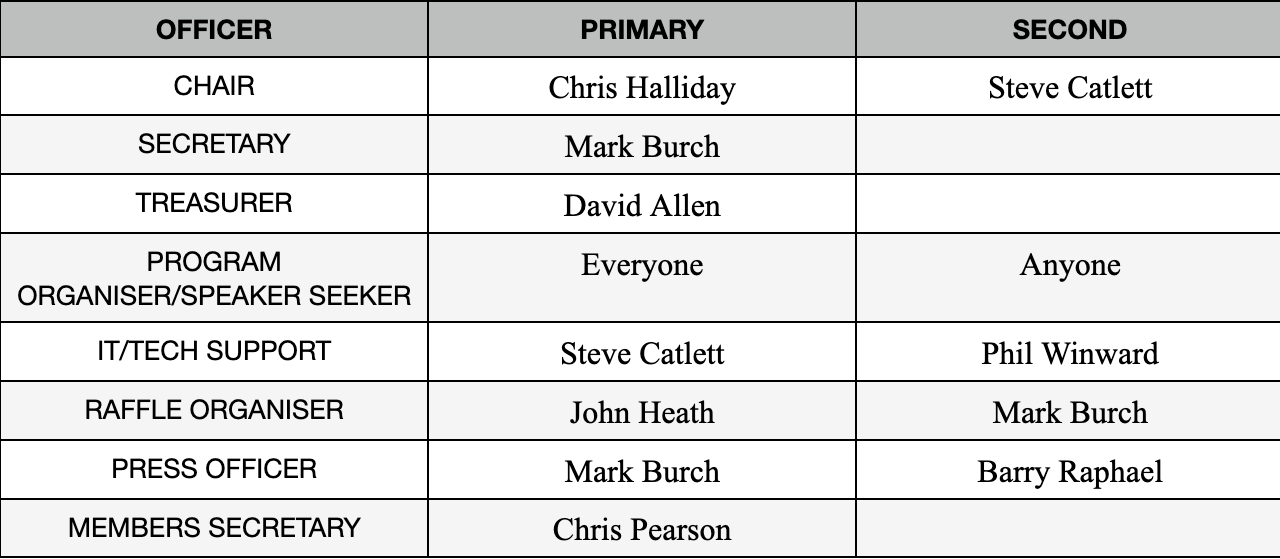
The meeting this month was that dirge of all societies and charities the Annual General
Meeting(AGM). The meeting kicked off at 1930 with a short statement from our chairman
Chris Halliday who went over the year and professed it a success and looked forward to
next year. There followed the normal course of AGM’s the world over with discussion
around officials and subscriptions. To save the reader from falling off their chair from
boredom suffice to say all positions were filled and the main headlines were to increase
the subs to £20 pa after it being held at the current rate for very many years. This was all
carried without any dissent. Also the Press Officer role was confirmed as yours truly! The
AGM was closed at 2050 and a welcome break to eat the delicious food & snacks that is
part of our evening meeting at the Mundford Bowls Club.
After the snacks and much light hearted discussion between friends a small quiz was
undertaken organised by our chairman on a vaguely aviation theme. I was one of the
successful prizewinners and I choose the “Battle of Britain Memorabilia” which contained a
pair of ‘Thermal Boots as worn by Sir Douglas Bader during the Battle (allegedly)”, think
about it…..
My prize winning question was knowing the answer to the question:
“In western Europe the F104 Starfighter was a very popular combat aircraft in the 70’s and
80’s, by popular myth what was the easiest way to obtain an example?”
If you know the answer to this you are at least as old as I am and probably have a military
background. In the meantime space dictates that I will have to leave you guessing but I
will reveal the answer in my next report. Merry Christmas and Happy New year to
everyone from WNAS.
Mark Burch
WNAS Scribe